

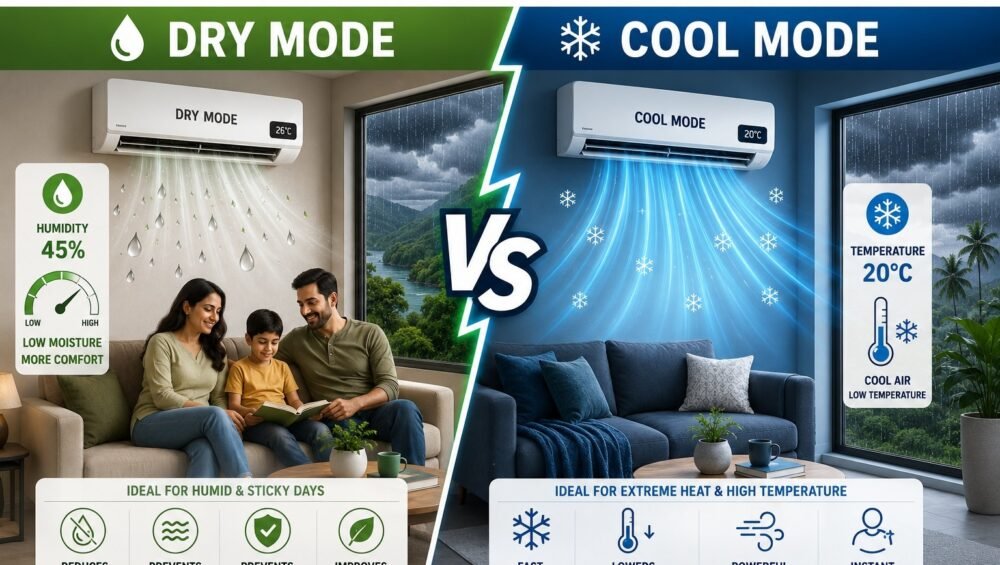
Monsoon season brings relief from intense summer heat, but it also creates a new challenge—high humidity. Even when temperatures are lower, excess moisture in the air can make indoor spaces feel sticky and uncomfortable. Many homeowners are unaware that modern air conditioners offer different modes designed for specific weather conditions. Understanding the difference between AC Dry Mode vs Cool Mode can help improve comfort, reduce energy consumption, and maintain a pleasant indoor environment during the rainy season.
AC Dry Mode is best for monsoon because it removes excess humidity while using less electricity. Cool Mode should only be used when both temperature and humidity are high.
What Is Cool Mode?
Cool Mode is the most commonly used air conditioning setting—the one most people default to when temperatures rise. Simply put, AC Cool Mode functions as a full-scale cooling system designed to lower indoor temperature to your desired level.
In Cool Mode, the compressor runs at full capacity to extract heat from indoor air and expel it outside. The thermostat continuously monitors room temperature and cycles the compressor on and off to maintain your set temperature, typically between 16°C and 30°C.
Key characteristics of Cool Mode:
- Primary function: Temperature reduction
- Compressor runs at maximum capacity
- Best for hot and dry weather
- Directly lowers indoor temperature
- Higher energy consumption
Cool Mode works exceptionally well when outdoor temperatures are high and humidity levels are relatively low. During peak summer months when the air is dry, Cool Mode efficiently manages indoor temperature without wasting energy on dehumidification.
What Is Dry Mode?
AC Dry Mode, often overlooked by users, is a specialized setting designed specifically for humid environments. Rather than cooling aggressively, Dry Mode removes excess moisture from indoor air while maintaining a relatively stable temperature.
In Dry Mode, the compressor operates intermittently at lower capacity. The AC unit prioritizes dehumidification over temperature reduction, removing moisture from the air without dramatically lowering room temperature. This mode runs the compressor just enough to extract humidity, then shuts it down—a more energy-efficient approach.
Key characteristics of AC Dry Mode:
- Primary function: Humidity removal
- Compressor runs intermittently at low capacity
- Best for humid and moderate-temperature weather
- Maintains temperature while reducing moisture
- Lower energy consumption
- Ideal during monsoon season
Dry Mode is perfect when humidity levels spike but temperatures aren’t excessively high—exactly the conditions you experience during monsoon months in cities like Noida and the surrounding regions.
How Do These Modes Work Differently?
The fundamental difference between AC Dry Mode vs Cool Mode lies in their operational strategy and priority.
Cool Mode operates with a “run continuously” mentality. The compressor remains active, refrigerant continuously circulates, and the system works relentlessly until your set temperature is achieved. Every cycle focuses on heat removal and temperature reduction.
Dry Mode adopts a “smart intermittent” approach. The compressor activates periodically—just long enough to remove moisture through the evaporator coil. Once humidity drops to acceptable levels, the system enters a standby phase, reactivating only when moisture accumulates again.
In Cool Mode, the air conditioner prioritizes lowering the room temperature, while humidity reduction occurs as a secondary benefit. This makes it highly effective during hot summer days when temperatures are high and rapid cooling is required.
In Dry Mode, the system focuses on extracting excess moisture from the air without significantly changing the room temperature. As humidity levels decrease, the indoor environment feels fresher, less sticky, and more comfortable, even if the temperature remains the same.
Why Humidity Increases During Monsoon
Understanding the monsoon moisture surge helps explain why AC Cool Mode alone isn’t always the solution. During monsoon season, relative humidity levels can soar to 80-95%, compared to 40-60% during summer.
Contributing factors:
- Constant rainfall saturates outdoor air with moisture
- Evaporation from wet surfaces increases water vapor
- Cloud cover reduces evaporative cooling effects
- Wind patterns push humid air indoors through ventilation
- Ground moisture rises through building foundations
When humidity climbs this high, cool air alone doesn’t solve the discomfort. Your AC must actively remove this excess moisture to create a genuinely comfortable indoor environment. This is precisely why best AC settings for monsoon always prioritize humidity control alongside temperature management.
Why Humidity Increases During Monsoon
Understanding the monsoon moisture surge helps explain why AC Cool Mode alone isn’t always the solution. During monsoon season, relative humidity levels can soar to 80-95%, compared to 40-60% during summer.
Contributing factors:
- Constant rainfall saturates outdoor air with moisture
- Evaporation from wet surfaces increases water vapor
- Cloud cover reduces evaporative cooling effects
- Wind patterns push humid air indoors through ventilation
- Ground moisture rises through building foundations
When humidity climbs this high, cool air alone doesn’t solve the discomfort. Your AC must actively remove this excess moisture to create a genuinely comfortable indoor environment. This is precisely why best AC settings for monsoon always prioritize humidity control alongside temperature management.
Read More: How to Increase the Life of Your Air Conditioner in Noida
Dry Mode vs Cool Mode: Comparison Table
Factor | Cool Mode | Dry Mode |
Primary Purpose | Temperature reduction | Humidity removal |
Compressor Operation | Continuous, full capacity | Intermittent, low capacity |
Ideal Season | Summer (hot, dry) | Monsoon (humid, moderate) |
Temperature Range | Below 20°C possible | 25-27°C typical |
Energy Consumption | High (100% baseline) | Low (60-70% of Cool Mode) |
Humidity Control | Secondary benefit | Primary function |
Response Time | Fast (5-10 minutes) | Gradual (20-30 minutes) |
Comfort in High Humidity | Poor (feels damp) | Excellent (feels fresh) |
Monthly Bill Impact | ₹2,500-4,000 (continuous use) | ₹1,200-1,800 (during monsoon) |
Best For | Peak summer months | Monsoon & pre-monsoon |
Which AC Mode Saves More Electricity During Monsoon?
Dry Mode wins decisively for monsoon electricity savings. Here’s the math:
If you run a 1.5-ton AC continuously:
- Cool Mode: 4-5 kWh per day (8-10 hours daily usage)
- Dry Mode: 2.5-3 kWh per day (intermittent, 8-10 hours)
Monthly savings with Dry Mode: ₹600-1,200 per month during monsoon season.
Over a 4-month monsoon period, Dry Mode can save ₹2,400-4,800 while actually improving comfort and air quality. Users report a 35-40% reduction in AC-related electricity costs when switching to Dry Mode during monsoon.
The Smart AC in Noida models automatically suggest Dry Mode during monsoon, recognizing this seasonal efficiency advantage.
How Smart ACs Automatically Manage Humidity
Modern Smart ACs are designed to maintain a comfortable indoor environment by automatically monitoring and controlling humidity levels. Using advanced sensors and intelligent technology, they adjust performance based on changing weather conditions, especially during the monsoon season. For homeowners looking for a reliable Smart AC in Noida, these advanced features help manage humidity, improve comfort, and ensure efficient cooling throughout the year.
Key features include:
- Real-time humidity monitoring
- Automatic switching between Dry Mode and Cool Mode
- AI-powered climate optimization
- Energy-efficient operation
- Remote control through mobile apps
These features help improve comfort, reduce excess moisture, and lower electricity consumption, making Smart ACs an ideal choice for humid weather conditions.
Read More: Meet Voltas Vertis AI: A Smart AC for Noida Homes
Common Mistakes to Avoid During Monsoon
Mistake 1: Running Cool Mode 24/7 Many users default to Cool Mode without considering seasonal needs. This wastes electricity without improving comfort.
Mistake 2: Setting temperature too low Dropping to 18-20°C in Dry Mode is unnecessary and increases energy waste. Maintain 25-26°C for optimal comfort and efficiency.
Mistake 3: Ignoring humidity readings Smart thermostats show humidity levels. If humidity is below 60%, Cool Mode may be appropriate. Above 70%? Switch to Dry Mode.
Mistake 4: Never cleaning filters Dirty filters reduce both cooling and dehumidification efficiency. Clean filters monthly during monsoon.
Mistake 5: Sealing windows completely Some air circulation is necessary. Completely sealed spaces can trap moisture and create musty odors. Allow minimal natural ventilation.
Where Can You Buy the Best AC in Noida?
Looking for a reliable AC Dealer in Noida? Ace Technomark offers smart and energy-efficient air conditioning solutions designed for Indian weather conditions. From advanced cooling features to humidity control options, you can find AC models suitable for both summer heat and monsoon humidity.
Visit our AC Showroom at J-36/37, Near Foot Over Bridge, Sector-18, Noida or contact us at 082856 66888 to explore the latest AC options and choose the right cooling solution for your home or office.
FAQS
What’s the Ideal Humidity Level Indoors During Monsoon?
The ideal indoor humidity level year-round is 40-50% relative humidity. During monsoon, maintaining this range using AC Dry Mode prevents both excessive humidity and over-drying.
Should I Switch to Dry Mode During Night or Keep Cool Mode?
Switch to Dry Mode at night during monsoon if temperature is below 25°C. The cooler nighttime air combined with Dry Mode maintains comfort while minimizing compressor operation.
How Much Electricity Does Dry Mode Save Compared to Cool Mode?
Dry Mode saves approximately 35-40% electricity compared to continuous Cool Mode operation. Monthly savings during monsoon typically range from ₹600-1,200, totaling ₹2,400-4,800 over a 4-month monsoon period.
Can Dry Mode Cause Health Issues or Make You Sick?
No, Dry Mode does not cause health issues. In fact, it promotes better health by maintaining optimal indoor humidity (30-50%), reducing mold, allergens, and respiratory problems associated with excessive humidity.